




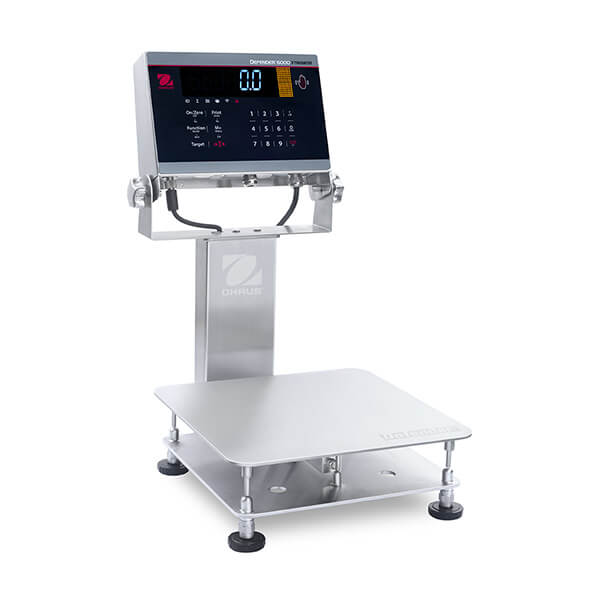
In a food production environment, a scale needs to do more than weigh accurately. It needs to survive water jets, chemical cleaning agents, and the relentless demands of a fast-moving production line without corroding, jamming, or creating a contamination risk. Our range of IP rated food production scales is engineered specifically for these conditions, combining high-precision measurement with the hygienic construction and washdown resistance that food safety compliance demands.
IP (Ingress Protection) ratings define how well a piece of equipment is sealed against solid particles and liquids. The two-digit code tells you everything you need to know: the first digit covers protection against solids (from 0 to 6), and the second covers liquids (from 0 to 9). In food production settings, the relevant considerations are:
Our range covers all three ratings, from compact bench washdown scales for portion control and ingredient weighing through to heavy-duty platform scales for bulk ingredient management. Key models include the Kern FOB and WTB-N bench scales, Ohaus Valor series (1000 through to 7000), Adam Equipment Aqua ABW washdown scales, and the Adam Gladiator and Kern SFB/SFE/SXC platforms for higher-capacity applications up to the Ohaus Defender 6000 for demanding industrial food environments.
Every food production scale in this range features stainless steel platform surfaces and, in most cases, stainless steel indicator housings. Stainless steel is the food industry standard because it is non-porous, resistant to corrosion from food acids and cleaning chemicals, and easy to disinfect without degrading the surface over time.
HACCP (Hazard Analysis and Critical Control Points) food safety programmes require that all equipment in contact with food or food preparation areas can be effectively cleaned without becoming a contamination source. IP-rated scales with sealed buttons, smooth surfaces, and no recessed areas where bacteria can accumulate are specifically designed to meet these requirements. Many models in the range carry explicit HACCP-compliance documentation to simplify audit processes.
Technically, nothing stops you from placing a standard bench scale in a food production area, but the practical and compliance consequences make it inadvisable. Standard scales with unsealed electronics, exposed buttons, and non-stainless platforms corrode rapidly when exposed to moisture and cleaning chemicals. The electronics fail prematurely, the display becomes illegible, and the platform surfaces can harbour bacteria in scratches and joints that standard cleaning cannot reach. More significantly, if your premises are subject to food safety audits under HACCP, BRC, or similar frameworks, auditors will identify non-washdown equipment in wet or food-contact zones as a non-conformity. Using equipment that is not rated for its environment is not just an operational problem, it is a compliance problem with potential regulatory consequences.
Tare and checkweighing. The ability to zero the scale with a container in place, then weigh the contents net, is fundamental for portion control and ingredient batching. Checkweighing functions allow the scale to signal when a reading falls outside a defined target range, which is essential for production line quality control.
Totalisation. For batching applications where multiple ingredients are weighed in sequence, totalisation accumulates readings so you know the combined weight without a separate calculation.
Data output. USB and RS-232 outputs allow weight data to be logged automatically to traceability systems, production management software, or label printers. For operations where documentation of batch weights is required, data output is not optional.
The distinction is primarily one of capacity and form factor. Bench washdown scales are compact units designed for counter or workbench use, typically covering capacities from a few hundred grams up to around 30kg. They are the right choice for portion control, ingredient weighing, and quality checks on smaller items. Platform washdown scales have a larger, floor-standing or recessed platform and cover higher capacities, from 30kg up to 600kg in most standard models, with heavy-duty options like the Ohaus Defender 6000 reaching further. They are used for weighing large ingredient deliveries, whole carcasses, bulk containers, and production batches where a bench scale simply does not have the capacity. Both bench and platform options in this range share the same IP-rated, stainless steel construction philosophy. The choice between them is determined by what you are weighing and how much it weighs. Need futher assistance in understanding which scale you need for your operations? Contact us today.