

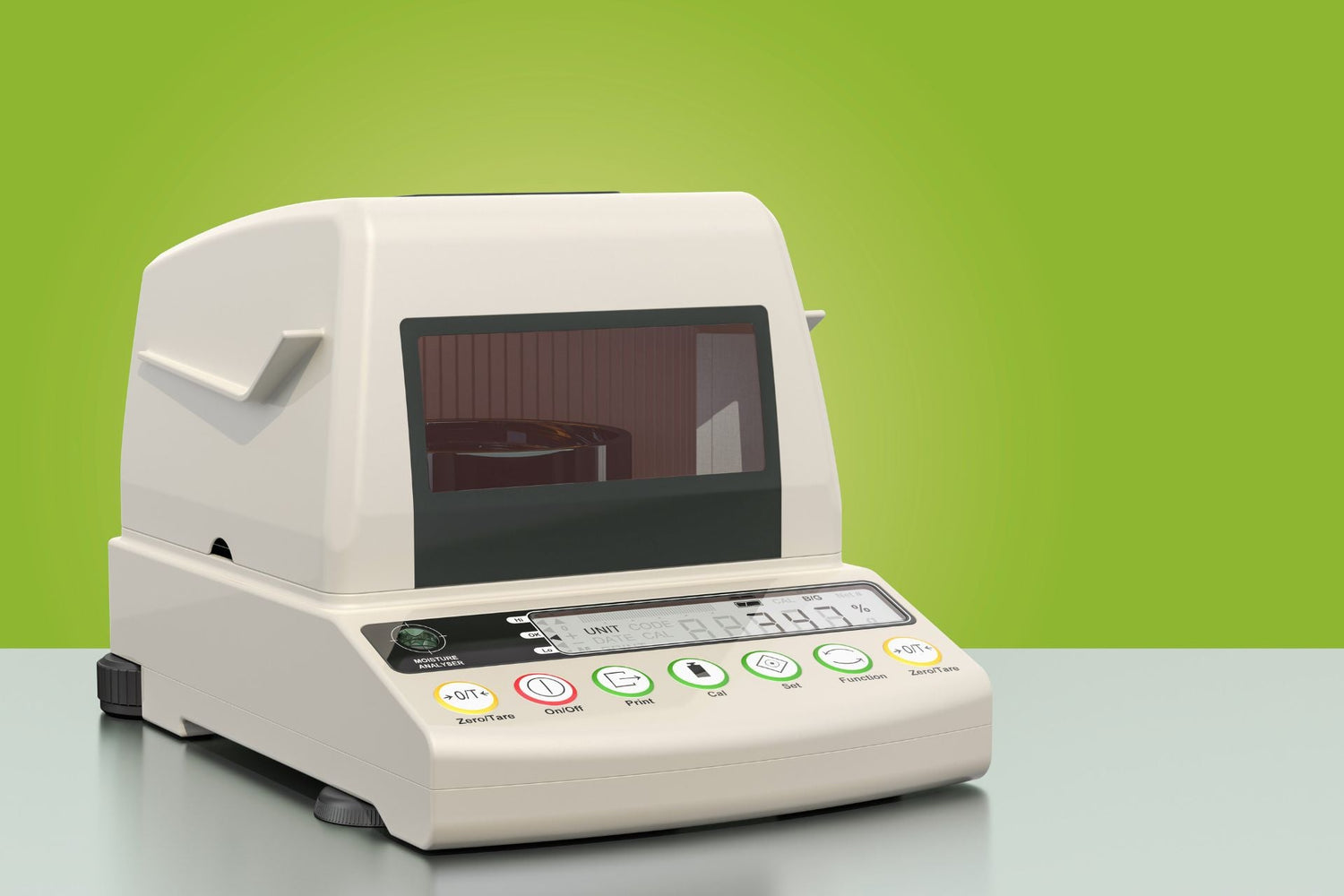
Every moisture analyser works on the same basic principle. Weigh the sample, heat it, weigh it again. The difference tells you the moisture content. Simple enough. But the way the instrument generates that heat makes a real difference to your test speed, accuracy, and the range of materials you can reliably measure.
The two main heating technologies on the market are halogen and infrared. Both do the job. But they do it differently, and the right choice depends on what you are testing, how fast you need results, and what you are prepared to spend.
How Halogen Heating Works
A halogen moisture analyser uses a tungsten heating element inside a glass tube filled with halogen gas. When activated, it reaches operating temperature in seconds and radiates heat across the entire sample surface with good uniformity.
That fast ramp-up time is the main advantage. A halogen unit can complete a moisture test in 5 to 10 minutes for most common sample types. It also means less thermal lag, so the analyser responds quickly to the drying curve and knows when to stop. This matters for throughput in a busy production environment where you need results fast to release batches or adjust processes.
The even heat distribution also reduces the risk of sample scorching, which is important when you are working with heat-sensitive materials like pharmaceuticals, fine powders, or food ingredients.
How Infrared Heating Works
An infrared moisture analyser uses an infrared element, typically a ceramic or quartz heater, that emits radiation absorbed directly by the sample material. The heating is slower to reach full temperature compared to halogen, and heat distribution across the sample surface can be less uniform.
For many routine applications, this is perfectly adequate. If your testing schedule allows 10 to 20 minutes per sample and your materials are not particularly heat-sensitive, an infrared unit delivers reliable results at a lower upfront cost.
However, infrared heating has a limitation with dark-coloured or densely pigmented samples. Dark materials absorb more infrared radiation at the surface, which can create localised hot spots. The outer layer scorches before the interior moisture has fully evaporated, giving you an inaccurate reading. This is less of an issue with lighter materials.
Is Halogen or Infrared Faster for Moisture Analysis?
Halogen is faster. The lamp reaches full temperature almost instantly and maintains consistent output throughout the drying cycle. A typical halogen test takes 5 to 10 minutes depending on the sample. Infrared units generally need 10 to 20 minutes for the same material.
If you are running dozens of moisture checks per day in a production environment, that time difference adds up. In a lab where you might run three or four tests a day, the speed gap matters less.
Which Heating Method Is Better for Dark-Coloured Samples?
Halogen. The more uniform heat distribution means less risk of surface scorching on dark or densely pigmented materials. Infrared radiation is absorbed more aggressively by dark surfaces, which creates uneven drying. If your application involves testing soil, dark spices, carbon-based compounds, or pigmented polymers, a halogen analyser will give you more consistent results.
For light-coloured samples like flour, sugar, dairy powders, or white pharmaceutical powders, both technologies perform comparably.
Cost and Value Comparison
Infrared moisture analysers are generally cheaper upfront. Entry-level infrared models start below £1,000, while halogen units typically begin around £1,200 and go up depending on capacity, readability, and features.
But the real value calculation depends on throughput and application complexity. If your testing volume is high, the time savings from halogen heating quickly justify the higher purchase price. If you are running low-volume checks on straightforward materials, an infrared model offers good value.
Both types require minimal ongoing maintenance. Replacement heating elements are available for both technologies, though halogen lamps are slightly more expensive to replace.
Do Halogen Moisture Analysers Cost More Than Infrared Models?
Yes, typically by 20 to 40 percent for comparable specifications. But the cost difference has narrowed as halogen has become the standard heating technology across the market. Many mid-range moisture analysers now use halogen as default, with infrared reserved for budget-tier models.
When factoring in test speed, sample versatility, and long-term running costs, halogen represents better value for most professional applications. Infrared remains a sensible choice for education settings, low-volume QC, and applications where budget is the primary constraint.
Choosing the Right Moisture Analyser for Your Application
If your work involves high-throughput testing, dark or varied sample types, or regulated environments where speed and consistency matter, choose halogen. If your application is low-volume, budget-sensitive, and involves light-coloured, straightforward materials, infrared will do the job well.
We stock both technologies from Kern, Ohaus, and Adam Equipment. If you also need precision weighing equipment for your lab, browse our full range of laboratory balances. And if you are not sure which specification fits your workflow, get in touch with our team. We have been advising on instrumentation for over 40 years.


Leave a comment
This site is protected by hCaptcha and the hCaptcha Privacy Policy and Terms of Service apply.