A refractometer can make a routine check much easier: a few drops of sample, a reading, and a useful indication of concentration. The buying decision takes a little more thought. An instrument sold for honey, coffee or coolant may look similar, yet the scale behind the reading can be quite different.
Start with two questions: what are you testing, and what result do you need? This guide explains the main refractometer types, when an analogue or digital model makes sense, and which specifications are worth comparing before you order.
If you already know your application, browse our Kern refractometers and use the Type filter to narrow the selection.
What does a refractometer measure?
A refractometer measures refractive index: how light behaves as it passes through, or meets the boundary of, a sample. The instrument converts this optical measurement into a reading on its fitted scale. Depending on the model, that might be Brix, honey moisture, salinity, coffee total dissolved solids or a glycol freezing-point indication.
The conversion depends on the sample. A scale developed for one substance cannot automatically give the correct concentration of another. That is why the choice of scale matters at least as much as the measuring range.
Which type of refractometer do you need?
| Your sample or task | What to look for | Check before buying |
|---|---|---|
| Juice, sugar solutions and suitable food samples | Brix refractometer | Expected Brix range and the effect of other dissolved ingredients |
| Honey | Dedicated honey moisture scale | Water-content range and scale divisions |
| Water-miscible cutting fluid | Suitable Brix refractometer | The coolant supplier’s refractometer factor |
| Glycol antifreeze | Appropriate ethylene or propylene glycol scale | Fluid type and whether concentration or freezing point is needed |
| Brine or seawater | Suitable NaCl or seawater scale | Sample composition and units |
| Brewed coffee | Coffee TDS refractometer | TDS range, resolution and sample preparation |
| Grape must or brewing wort | Wine or brewing scales | Whether the sample is being tested before or after fermentation |
Brix refractometers: choosing the right range
A Brix refractometer is often the starting point for checking juice, sugar solutions and suitable process liquids. In a pure sucrose–water solution, 10 °Brix means 10 g of sucrose per 100 g of solution. In a more complex sample, other dissolved substances affect the result, so the reading needs to be interpreted in context.
For work within 0–32% Brix, the Kern ORA 32BA analogue Brix refractometer is a straightforward option to compare. If your working concentrations are lower, a narrower-range model may be more useful: the ORA 10BA covers 0–10% Brix with 0.1% scale divisions.
For a digital reading, compare the ORM 50BM digital Brix refractometer, covering 0–50% Brix. Concentrated samples may need a higher-range instrument. Choose around the values you actually expect to measure; the widest range is not automatically the most useful choice.
Honey refractometers: look for a moisture scale
If your main question is “how much water is in this honey?”, choose a refractometer that displays honey water content directly. A standard low-range Brix model will not cover the same task.
The Kern ORA 6HA honey moisture refractometer measures water content from 12–30%, with 0.1% scale divisions. It is worth considering when you want an analogue instrument focused on that measurement.
The ORM 1HO digital honey refractometer offers water-content, Brix, Baumé and refractive-index scales. Compare it if you need several readings or prefer an electronic display. In either case, check the reference-check procedure: some analogue honey models use a glass block and specified contact liquid rather than a water zero check.
Coolant refractometers: cutting fluid or antifreeze?
“Coolant refractometer” can describe two different jobs. Establish which one you need before choosing a model.
Water-miscible metalworking coolant
For a compatible cutting-fluid emulsion, a Brix reading usually needs conversion using the fluid supplier’s refractometer factor. For example, if the supplier specifies a factor of 1.5, a reading of 4 °Brix gives an indicated concentration of 6%. That example is only valid for a product whose instructions specify that factor.
Ask for the factor for your exact coolant and follow its sampling method. Contamination, tramp oil and mixed fluids can affect the reading. A suitable low-range Brix instrument is often more useful here than a model intended for concentrated sugar products.
Glycol antifreeze
For vehicle or process antifreeze, look for the correct ethylene glycol or propylene glycol scale. The ORA 4FA automotive refractometer includes dedicated glycol freezing-point scales, alongside screenwash and battery-fluid scales. The ORM 2CA digital glycol refractometer offers glycol concentration and freezing-point scales.
Check the actual fluid formulation and required result. An instrument offering AdBlue and screenwash readings does not necessarily include glycol scales.
Salinity refractometers: match the scale to the water
For salt measurements, establish whether you need a sodium chloride concentration scale or a scale intended for seawater. Brine and seawater have different compositions, so the label “salinity” alone is not enough to make the choice.
The Kern ORM 1SW seawater refractometer provides a dedicated seawater salinity scale covering 0–100‰, as well as specific gravity. For NaCl solutions, compare the relevant salt models in the collection. Check whether your procedure records percent, parts per thousand or specific gravity, and use the appropriate scale consistently.
Coffee refractometers: compare TDS and resolution
A coffee refractometer helps put a number on brew strength using a coffee TDS scale. It is useful when you want to compare recipes, batches or changes to a brewing process. A general sugar Brix reading should not simply be treated as coffee TDS.
The Kern ORM 2CO coffee refractometer covers 0–25% coffee TDS with 0.01% resolution. Those display increments are a separate specification from accuracy. Before comparing models, also consider how you will prepare and cool samples and keep the prism clean. A consistent sampling routine makes comparisons much more useful.
Wine and brewing refractometers: allow for fermentation
Refractometers are convenient for checking grape must and brewing wort before fermentation. Dedicated scales can make the result easier to use within your existing process.
For grape must, the Kern ORA 1WA wine refractometer provides Brix, Oechsle and KMW scales. For brewing, the ORM 1BR digital brewing refractometer includes Brix, wort specific gravity and Plato.
Once fermentation starts, alcohol changes the refractive-index reading. A direct reading then needs an appropriate correction or alternative method; it cannot simply be interpreted as the remaining sugar or finished alcohol content. Keep the original reading if your calculation method requires it. A potential-alcohol scale estimates an outcome from initial sugar rather than directly measuring the strength of a finished drink.
Digital or analogue refractometer?
An analogue handheld model can be a good fit for occasional checks on one type of sample. You read the boundary against an optical scale, and the measurement itself needs no battery. Compare the scale clarity, divisions and any temperature-compensation feature.
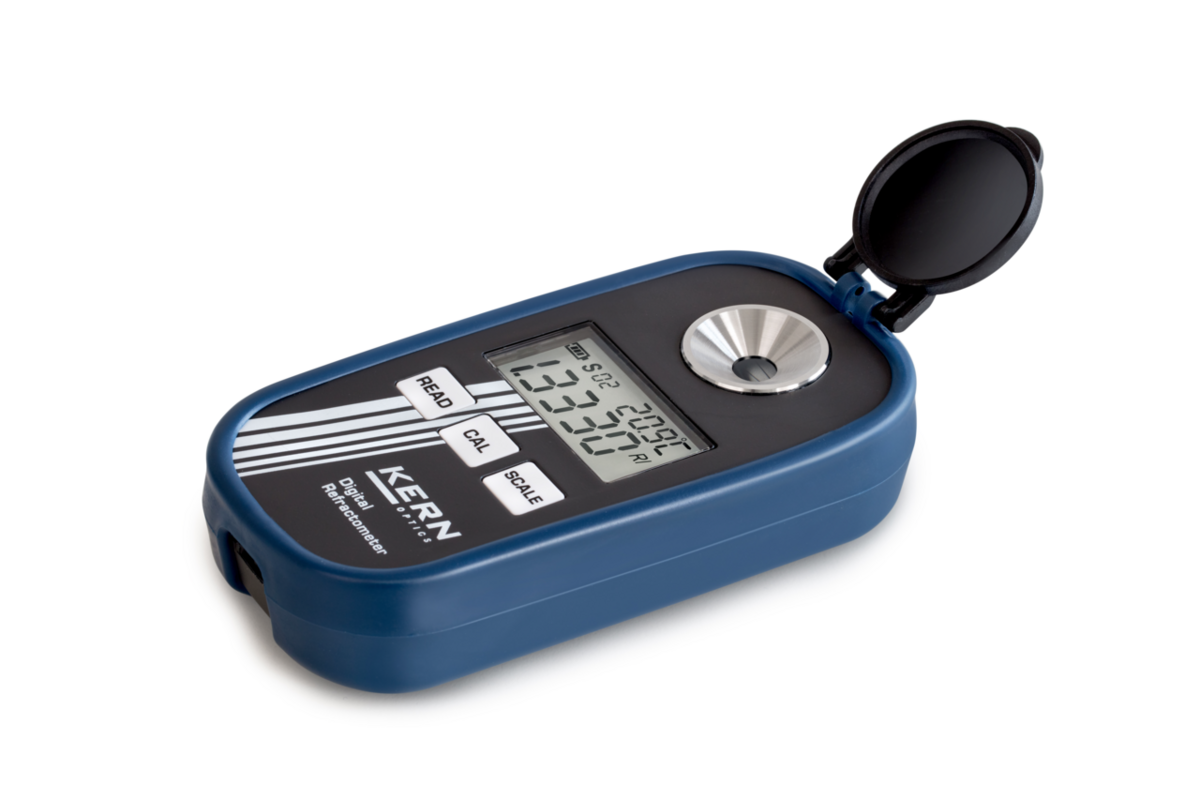
A digital refractometer displays a numerical result, which can make repeated checks easier to read and record. It can also offer several application scales in one instrument. Check which scales are actually included: digital operation does not make an instrument suitable for every liquid, or guarantee better accuracy.
For a fixed laboratory workstation, a desktop instrument may suit the routine better. The Kern ORL 94BS desktop Brix refractometer is one option for bench-based Brix and refractive-index work.
What about urine and laboratory refractometers?
Urine testing needs the correct specific-gravity scale, including species-specific scales where required. The ORM 2UN veterinary refractometer includes separate cat and dog urine scales. Do not assume serum protein measurement is included on every urine model.
For laboratory work where refractive index itself is the required result, compare the nD range and measurement method. The ORT 1RS Abbe laboratory refractometer belongs in that comparison. These specialist applications deserve their own model checks rather than selection from a general-purpose Brix specification.
Five checks before you order
- Sample and scale: confirm the instrument is intended for the substance and result you need.
- Working range: cover your expected readings without overlooking the scale divisions or digital resolution.
- Accuracy: read this separately from resolution. More decimal places do not establish a smaller measurement error.
- Temperature: check the measurement and automatic temperature compensation limits. ATC does not replace sample equilibration or correct the wrong scale.
- Reference checks and certification: establish the required liquid or block, and whether your quality procedure needs an instrument calibration certificate.
On our refractometer product pages, select Calibration Certificate: Yes if you need the calibrated option. A reference-check accessory is a separate purchase and does not itself provide an instrument certificate. You can also read our guide to why instrument calibration matters.
Find a refractometer for your application
Use the refractometer collection to compare the available models, then narrow the range by application. Open the product specifications to check the exact scales, ranges and supplied items before choosing.
If two models look equally suitable, ask GNW for help choosing. Tell us what you are testing, the expected concentration range and the units you need. That gives us a much better starting point than a model number alone.