

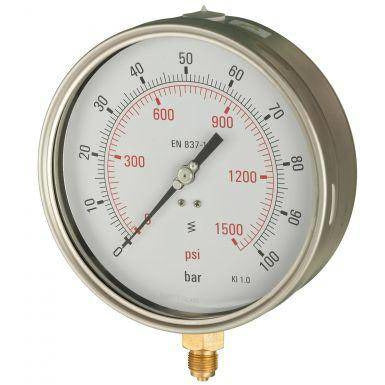
160mm Bottom Entry Industrial Pressure Gauge
160mm Bottom Entry Industrial Pressure Gauge
This 160 mm industrial pressure gauge provides a robust local indication point for plant, machinery and packaged equipment. The generous 160 mm dial is intended for installations where pressure needs to be checked from a greater working distance. The dry dial gives an immediate reading without electrical power and is suited to installations where vibration and pulsation remain within the capability of an unfilled gauge.
Its lower connection provides a conventional upright mounting arrangement, presenting the large dial clearly above the process connection. The upright format is appropriate for plant lines, manifolds and machinery where the gauge is read during routine inspection. For replacement work, compare the range, connection and mounting orientation with the existing gauge as well as the process conditions.
Learn more
Product specification
Compare model specifications.
Learn More
Technical Specification
Learn more
Applications
Features
FAQs
Is this gauge configured for bottom entry mounting?
Are the brass wetted parts compatible with my process media?
Why choose a glycerine filled industrial pressure gauge?
How should I assess the 1% accuracy value?
Compare the stated 1% accuracy against your required measurement tolerance and any site or equipment specification before ordering.