

How Accurate Are Digital Pressure Gauges Compared To Analogue
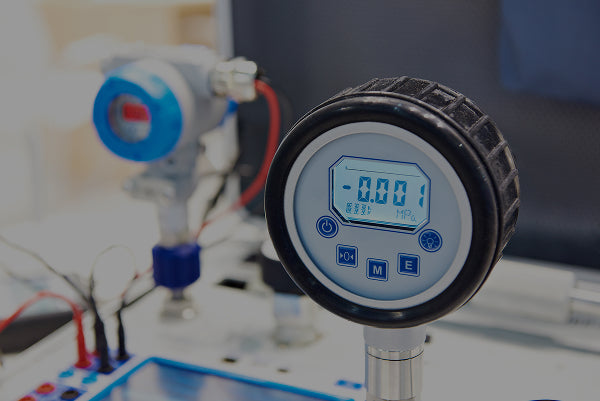
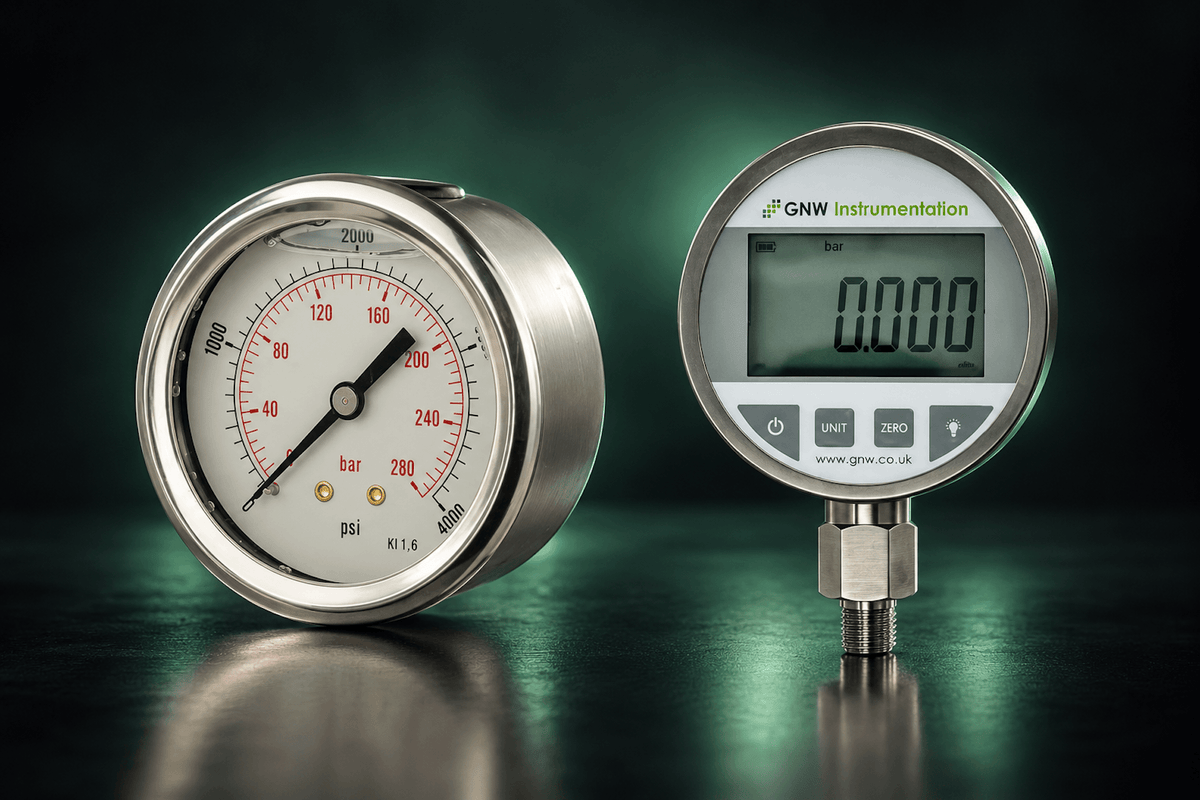
A digital pressure gauge looks more accurate before you've checked a single spec. A five digit display reading 4.0237 bar feels more precise than a needle sat between two lines on a dial, and that feeling is exactly where a lot of specification decisions go wrong.
Accuracy and the appearance of accuracy are not the same thing, and the gap between them is worth closing before an order goes in.
What Digital Gauges Are Actually Measured Against
BS EN 837, the standard most mechanical pressure gauges are specified against in the UK, covers Bourdon tube and diaphragm gauges specifically. It doesn't cover digital or electronic instruments at all. A digital gauge won't carry a BS EN 837 accuracy class because the standard was never written for it.
Instead, the datasheet states accuracy directly as a percentage of full scale, which means a digital spec and an analogue spec aren't using the same language, and comparing them properly means reading past the headline number on both. Our earlier piece on BS EN 837 pressure gauge accuracy classes covers how that standard works for mechanical gauges in full.
The Real Numbers, Not The Assumption
Here's where digital stops being one category. Our own digital pressure gauge range spans from ±1.0% FS on the GNW260, a compact 63mm digital gauge with a 4-digit display, through ±0.4% FS on the GNW200, our standard 100mm digital pressure gauge, down to ±0.05% FS on the GNW210, a dedicated digital reference gauge built for calibration and comparator work.
Set that against mechanical gauges. BS EN 837-1 defines seven accuracy classes, 0.1, 0.25, 0.6, 1, 1.6, 2.5 and 4.0, each one a percentage of the gauge's full scale span. A general purpose pressure gauge is typically built to class 1.6 or 2.5. That means the GNW260, at 1.0% FS, is tighter than a standard general purpose analogue gauge, but not by the margin most people assume when they picture digital versus analogue.
The GNW200 at 0.4% genuinely outperforms that same class 1.6 general purpose gauge by a real, usable margin. The GNW210 at 0.05% isn't playing the same game at all, it's built to verify other gauges, not sit on a pipe.
The point isn't digital beats analogue. It's that both categories span a real range, and the specific model on the page matters more than which technology it uses.
Resolution Is Not Accuracy
A fine display resolution and a tight accuracy tolerance are two different specifications that happen to sit on the same datasheet.
A 5-digit LCD reports pressure in smaller increments than a needle ever could, and that genuinely helps when you're trying to read a precise value rather than estimate where a pointer sits between two graduations. It also removes parallax error entirely, the reading error that comes from viewing a needle and dial from an angle, which is a real source of inaccuracy on analogue gauges that has nothing to do with the mechanism's actual tolerance.
None of that changes what the gauge is rated to within. A digital display reading to four decimal places on a ±1.0% FS gauge is reporting false precision, not real accuracy. The number looks more exact. It isn't.
Where Analogue Still Earns Its Place
Power is the obvious one. A digital gauge needs batteries, and a dead battery on a panel gauge is a gap in visibility at the exact moment someone needs the reading. A mechanical gauge has no power requirement and no failure mode tied to it.
Vibration and pulsation are the other real factor, a dry gauge of either type will blur or bounce on equipment with meaningful vibration, which is why a glycerine filled pressure gauge exists as a specific category rather than a premium add-on, the fill dampens pointer movement mechanically in a way a digital display doesn't need to, but a digital gauge's own sampling rate becomes the limiting factor instead, and a 2Hz or 3Hz refresh can visibly lag a fast-changing reading in a way a damped analogue needle won't.
Matching The Gauge To What The Reading Actually Does
This is the same principle that applies to picking an accuracy class, and it holds just as well across the digital and analogue divide. Decide what the reading is for before deciding how it should be displayed.
A calibration bench or comparator role needs the GNW210's reference-grade 0.05% FS, nothing else in either category gets close, and any gauge used for that purpose should sit within a UKAS accredited calibration chain if the reading needs to be traceable. A process reading that feeds a decision, a recorded measurement, or anything closer to a control function justifies the GNW200's 0.4% FS.
A compact panel location where decent accuracy matters more than reference-grade precision is a reasonable fit for the GNW260. A routine visual check, an operator glancing at a gauge during a walk round, rarely needs better than a class 1.6 or 2.5 general purpose gauge, and no digital display resolution changes that calculus.
Equipment with real vibration or pulsation points toward a glycerine filled gauge regardless of which technology drives the display.
For a full comparison across every model, the digital pressure gauges range and the industrial pressure gauges range sit side by side in the pressure guages here


Leave a comment
This site is protected by hCaptcha and the hCaptcha Privacy Policy and Terms of Service apply.