

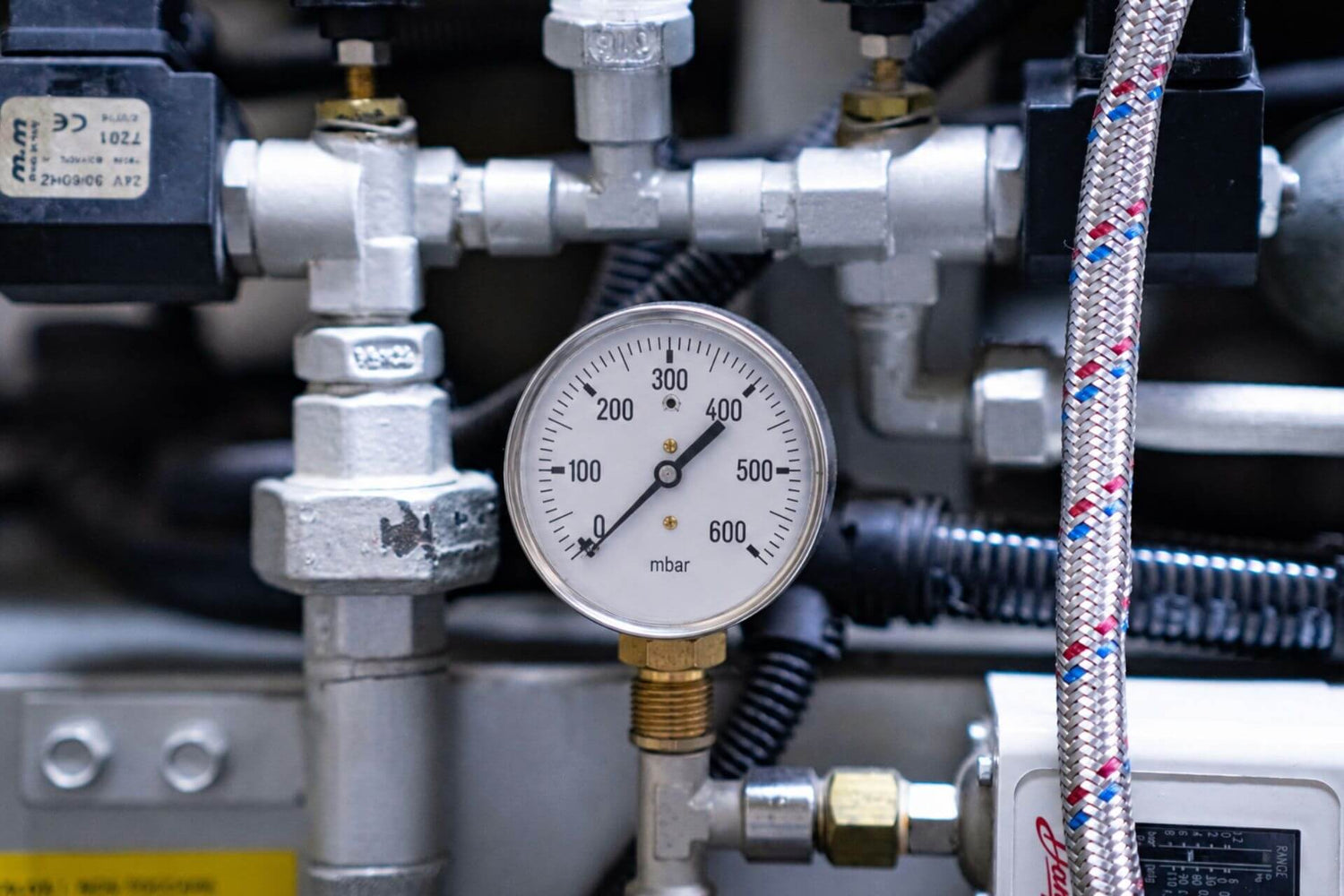
Specify a standard bourdon gauge on a low pressure line and it will often still turn, just not by much. A pressure change that would move a capsule gauge's pointer across half the dial barely nudges a bourdon tube built for a wider range. Low pressure gauge selection comes down to which mechanism, capsule or bourdon tube, actually deflects enough to give a usable reading at the pressures involved. This looks at how each one works, where the practical crossover point sits, and how to specify the right one for an OEM build.
How Does a Bourdon Pressure Gauge Work?
A bourdon tube pressure gauge uses a curved, flattened tube, sealed at one end and connected to the process at the other. Pressure inside the tube tries to straighten its curve. That movement is small, but a linkage and gear mechanism amplifies it into a full sweep of the pointer across the dial. The principle is Hooke's Law, the tube's own elastic resistance returns force equal to the pressure pushing against it, and that balance is what the dial reads. A bourdon gauge is the default mechanical movement across most of the range, reliable and well suited to medium and higher pressures where the tube has enough force behind it to deflect predictably. Our note on how does a bourdon pressure gauge work goes through the mechanism in more depth.
How Does a Capsule Pressure Gauge Work?
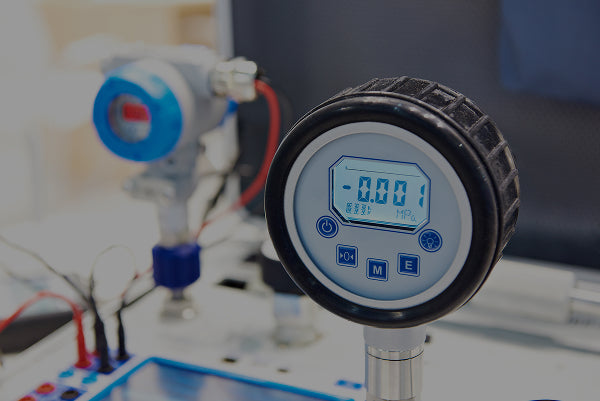
A capsule pressure gauge replaces the tube with two corrugated diaphragms welded together to form a sealed capsule. Pressure inside expands the capsule slightly, and because the diaphragm surface area is far larger than a bourdon tube's cross section, that same small pressure produces a proportionally bigger mechanical movement. It's the same Hooke's Law principle, just applied to a shape built for sensitivity rather than range. A low pressure capsule gauge can register pressure changes a bourdon tube would barely show at all, which is the entire reason the mechanism exists. Diaphragm and capsule gauges are covered under BS EN 837-3, the standard written specifically for this movement type, separate from the bourdon tube gauges covered under BS EN 837-1.
Capsule vs Bourdon Tube Gauges for Low Pressure Measurement
Four things actually decide which mechanism belongs at a given point on a panel.
Pressure Range
Below roughly 0.6 bar, a bourdon tube's deflection becomes too small to read reliably. Capsule gauges are built for exactly this gap. Our 63mm, 80mm and 100mm bottom entry low pressure capsule gauges all cover a 0 to 40 millibar range, comfortably below where a bourdon tube gauge stays practical.
Readability and Resolution
A bourdon tube gauge scaled for 0 to 40 millibar would compress that entire range into the first few degrees of pointer movement, unreadable in practice. A capsule gauge spreads the same range across a full dial sweep, which is the actual resolution advantage rather than a marketing one.
Application and Media
Capsule gauges are specified for clean, dry gases and air rather than liquids. A bourdon tube pressure gauge handles a far wider spread of media, including liquids, which is where a general purpose pressure gauge takes over from a capsule gauge entirely.
Installation and Connection
Both mechanisms are available as a bottom entry pressure gauge for upright installation directly on pipework, manifolds and gauge valves. Where a panel needs the dial facing forward rather than the connection coming from below, a back entry industrial gauge is the equivalent option on the bourdon tube side. Capsule gauges in this range are bottom entry only.
When Should You Choose a Low Pressure Capsule Gauge?
Choose a capsule gauge wherever operating pressure sits under roughly 0.6 bar and the media is a clean, dry gas. Filtration differential pressure, low pressure air regulation and gas panel monitoring are the typical OEM applications, anywhere sensitivity at the low end matters more than covering a wide range.
When Is a Bourdon Gauge the Better Choice?
Choose a bourdon gauge for anything above that range, for liquids regardless of pressure, or wherever cost and simplicity outweigh the sensitivity a capsule offers. Our general purpose pressure gauges range covers the bulk of standard OEM and panel-building specifications that sit outside the low pressure capsule bracket.
Are Capsule Gauges Suitable for Air and Gas?
Yes, specifically clean, dry gases. Air, nitrogen and other non-corrosive dry gases are exactly what the capsule movement is specified for. Wet gases or anything carrying particulate can affect the diaphragm over time, so media compatibility is still worth confirming rather than assumed from the word gas alone.
What Pressure Range Is Suitable for a Low Pressure Gauge?
0 to 40 millibar covers the full capsule gauge range across all three dial sizes. That sits comfortably below where a bourdon tube gauge stays readable, which is exactly the gap a low pressure gauge exists to fill.
What Should OEMs Consider When Specifying a Low Pressure Gauge?
- Confirm actual operating pressure sits within the 0 to 40 millibar capsule range before defaulting to a bourdon tube gauge.
- Confirm the media is a clean, dry gas, not a liquid or particulate-laden gas.
- Match connection size to the panel, 1/4 inch BSPT on the 63mm, 3/8 inch BSPT on the 80mm, 1/2 inch BSP on the 100mm.
- Confirm bottom entry suits the installation, since capsule gauges in this range don't come in a back entry format.
- Check accuracy class against what the reading actually needs. Capsule gauges in this range hold 2.5% of full scale.
Specify the Right Mechanism
Match the mechanism to the actual pressure and media before ordering, not the other way round. Browse the low pressure capsule gauges range for anything under 0.6 bar on clean dry gas, or the general purpose pressure gauges range for everything above it.

Leave a comment
This site is protected by hCaptcha and the hCaptcha Privacy Policy and Terms of Service apply.