



The label on a collection page doesn't tell you whether a gauge belongs on a pharmaceutical line. A sanitary pressure gauge is defined by wetted material, connection design and documentation, not by which category it's filed under on a supplier's website. Two gauges can share a dial size and a pressure range and still be entirely different propositions once you look at what's actually in contact with the process. This covers what to check before specifying one, and where the marketing term stops being useful.
What Requirements Should Pharmaceutical Pressure Gauges Meet?
Four things determine whether a gauge is fit for a regulated line. Wetted material compatible with the process media and any CIP or SIP chemistry it will see. A connection type that matches the hygienic standard the line is built to, not just a thread that physically fits. Accuracy appropriate to the control loop the reading feeds into, not just whatever the catalogue default happens to be. Documentation that supports validation, meaning a traceable calibration certificate and a defined recalibration interval, not a gauge that arrives with nothing to show an auditor. Pharmaceutical pressure gauges get specified against these four points individually. None of them are optional, and none of them can be inferred from a product name.
Selecting Pressure Gauges for Pharmaceutical Processes
Getting this stage wrong is the single most common mistake when specifying pharma pressure gauges for a new line. Start with whether the gauge is product-contact or utility-side, since that single distinction changes almost every other decision that follows. A gauge monitoring compressed air feeding a pneumatic actuator doesn't need the same wetted material as one mounted directly on a product line. Pressure range comes next, sized so normal operating pressure sits well clear of full scale rather than crowding it, the same principle that governs any industrial gauge selection but with less tolerance for getting it wrong on a validated system. Connection type has to match what the line was actually built to, threaded BSP is standard on most catalogue gauges, and if the installation calls for a tri-clamp or DIN 11851 fitting instead, that needs confirming with the supplier before ordering rather than assumed.
Sanitary and Hygienic Considerations for Pressure Gauges
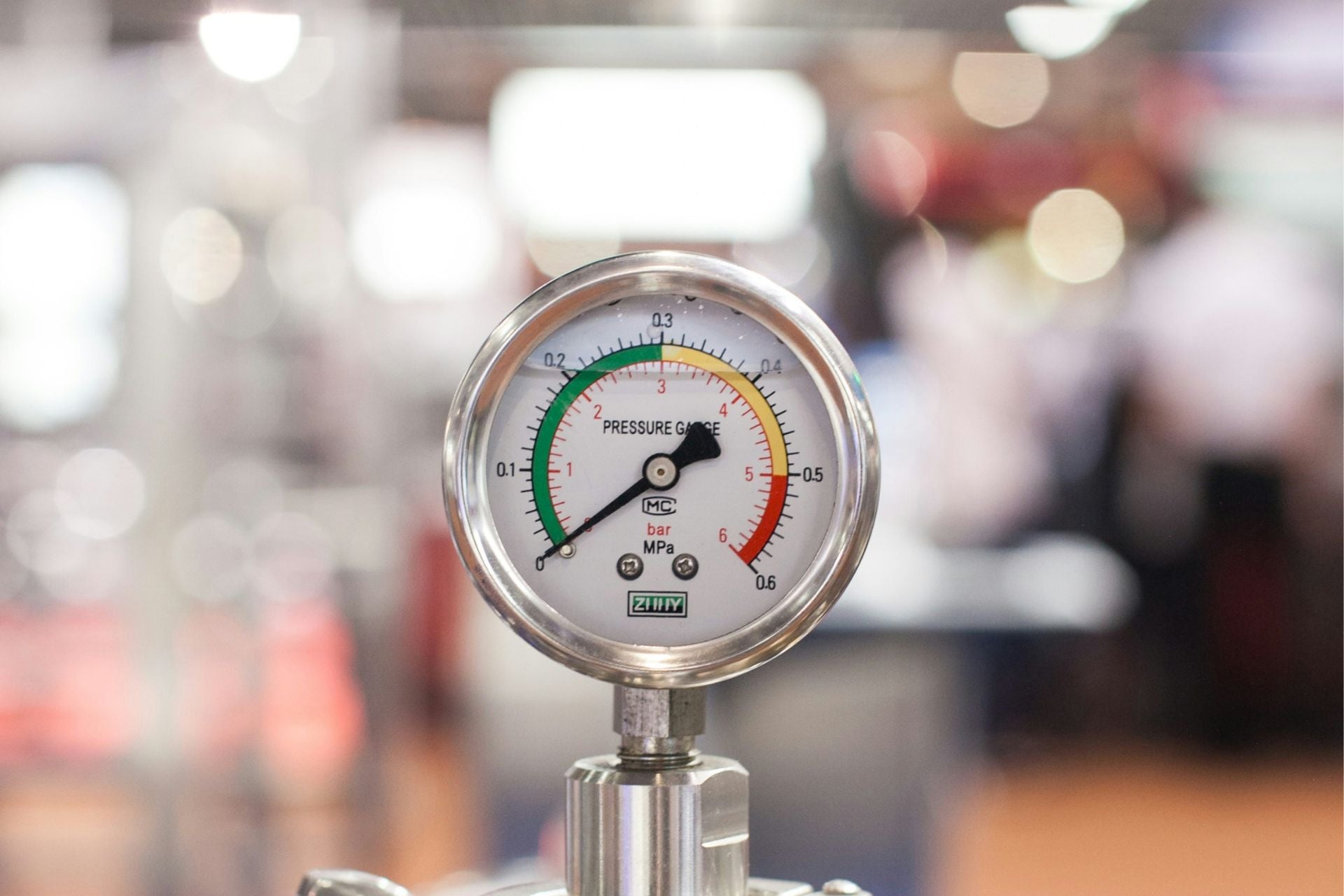
Sanitary gets used loosely across the industry, often meaning little more than stainless steel construction. What actually matters is whether the wetted surface is crevice-free, whether the connection traps CIP fluid or product residue in a dead leg, and whether the surface finish holds up to repeated washdown without degrading. A hygienic pressure gauge earns that description through those specifics, not through the material alone. Our all stainless steel pressure gauges range is built with 316 stainless steel wetted parts and is suited to washdown environments as standard, a solid baseline even where the connection still needs matching to whatever hygienic standard your line specifies. Confirm that detail before assuming a stainless case makes a gauge automatically hygienic-grade.
Pressure Gauge Materials and Wetted Parts
Case material and wetted material are two different specifications, and conflating them is where most wrong selections happen. Our all-stainless range uses a 304 stainless steel case with 316 stainless steel wetted parts, the grade distinction matters because 316 carries better resistance to chlorides and process chemistry than 304 does. A general purpose gauge listing rarely states its wetted material as clearly as that. If it isn't specified, that's exactly the point. Don't assume it's suitable for product contact. Our general purpose pressure gauges range is built for air, water and oil utility service, compressed air panels and cooling circuits, not product-contact duty, and the wetted material should always be confirmed directly before specifying any gauge for pharma use.
Accuracy and Calibration Requirements for Pharmaceutical Applications
A traceable calibration certificate is a baseline requirement, not an add-on worth skipping to save a line item. Calibration means testing the gauge at multiple pressure points against a certified reference, recording deviation from true value, and issuing documented evidence the instrument performs within tolerance. For ISO 9001 and similar quality systems, that traceability to national standards is what supports an audit rather than a verbal assurance the gauge was checked at some point. Accuracy class varies across our digital range rather than being one fixed figure, our 100 mm GNW200-ABS is built to ±0.4% of full scale, our dedicated reference gauge tightens that to ±0.05%, and every one of them ships with a traceable calibration certificate as standard, which is what a pressure gauge with calibration certificate should mean by default rather than as a special order. Recalibration frequency should track the criticality of the measurement point, not a blanket annual date applied regardless of how the gauge is actually used.
Mechanical vs Digital Pressure Gauges
Mechanical Bourdon tube gauges need no power, are familiar to operators at a glance, and remain a defensible choice for simple local visual indication. They don't hold up as well where the requirement is documented evidence of a specific reading, since there's nothing to log and nothing to output. A precision digital pressure gauge closes that gap.
Our digital pressure gauges range offers tighter resolution at low pressure and a 5-digit LCD readout that removes needle-reading ambiguity, with accuracy classes running from ±1.0% full scale on the compact 63 mm models up to ±0.4% on the standard 100 mm series. A digital sanitary pressure gauge combines the right accuracy class with the wetted material and connection considerations already covered, and it's worth specifying that combination explicitly rather than treating digital and hygienic as separate decisions.
Pressure Gauges for Filtration and Process Monitoring
Filter housing differential pressure is one of the most common pharma gauge applications, and it's also one of the easiest to under-specify. Sterile filtration and HVAC filter monitoring both operate at low differentials where a standard Bourdon movement loses resolution fast, which is where a low pressure capsule gauge holds its accuracy where a general-range gauge would just show noise. Pressure monitoring immediately after a feed pump is a different problem entirely, the reading itself is fine but pulsation makes it unreadable, and a glycerine filled gauge dampens that movement rather than leaving an operator trying to average out a bouncing needle. Vacuum-referenced processes, lyophilisation and vacuum degassing among them, need an absolute reference rather than a gauge pressure reading, since atmospheric variation would otherwise sit inside the measurement uncorrected. That's a separate specification decision from the material and hygiene questions already covered, and it needs answering just as deliberately.
What to Consider When Specifying a Pharmaceutical Pressure Gauge
Confirm whether the point is product-contact or utility-side before anything else, since that answer decides the material conversation entirely. Match wetted material to the process media and its CIP or SIP chemistry, not just to what's already fitted elsewhere on the line. Specify connection type against the actual hygienic standard in use rather than assuming a thread that fits is a thread that's appropriate. Set accuracy class against what the control loop actually needs, and confirm the calibration certificate and recalibration interval are documented before the gauge goes anywhere near a validated system. Our industrial pressure gauges range covers the commercial models most of these specifications map onto once the requirement itself is properly defined.
Specify With Confidence
Getting the material, connection and calibration requirements right before ordering avoids a rejected instrument at goods-in. Browse our full pressure gauges range to compare specifications side by side, and see our note on why calibration matters for what a proper certificate should actually include.


Leave a comment
This site is protected by hCaptcha and the hCaptcha Privacy Policy and Terms of Service apply.